Research note
From Formal Authority to Practical Human Control
Publication status: On hold pending arXiv approval. The manuscript download is withheld pending permission for public release. It is not presented as an approved arXiv publication. Status record · 2026-09-15
- What makes human control practical?
This study asks what evidence establishes that a person could affect an automated decision. It applies a six-stage assessment to three historical cases:
- Neither Patriot case passed, despite supported intervention authority.
- Oko remained unresolved because all six stages were only partially supported.
- A preserved correction shows how a stricter evidence rule changed the Oko findings without changing the historical packet.
- Scope of the result.
Three deliberately selected, retrospective cases; one assessor. The study demonstrates a procedure. It does not establish prevalence, causal effects, independent reliability, or transfer to current AI systems.
- Paper and materials.
Source material under publication review · Research repository · Registry record
Why test a claim of human control?
Institutions can assign responsibility without preserving the conditions needed to exercise it. A reviewer may have permission to stop an action yet lack usable information, sufficient time, or an effective route for changing execution. Treating the role assignment as proof can conceal a failed safeguard and place responsibility on someone who lacked practical power.
The research question is therefore documentary: what evidence would justify a claim that human authority had practical force in one consequential decision? The method evaluates the surviving record within a declared boundary. It does not assign personal blame or assess moral character.
Practical Human Control is the assessment method presented here. Trust, Autonomy & Evidence (TAE) is the broader research architecture. Source material under publication review.
Setup: cases, records, and selection
The unit of analysis is one bounded machine-mediated decision or action sequence. The study uses a functional system definition: Oko concerns early-warning inference; the Patriot cases concern automated detection, classification, and engagement support. These historical systems differ materially from present learned models.
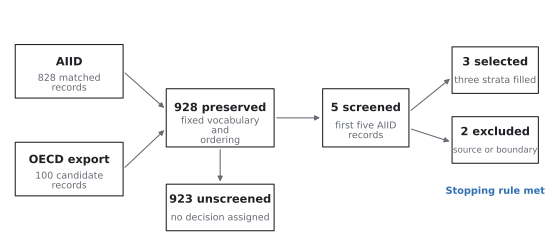
Screening stopped when each stratum was filled. The unscreened candidates were not rejected, and the selected cases are not a representative sample. The design demonstrates how the procedure behaves under anticipated evidence conditions. Source material under publication review.
Study design & boundary
- Design
- Retrospective methods demonstration; one assessor
- Evidence cutoff
- 6 August 2026, 23:59:59 UTC
- Selection
- Protocol and empty selection register frozen before screening
- Candidate pool
- 928 preserved candidate records
- Screening outcome
- Five screened; three selected; two excluded; 923 left unscreened
- Selection purpose
- Fill three prespecified strata covering contrasting intervention and evidence conditions
Why these three cases?
The selection figure records five screening decisions from a preserved pool of 928 candidates. Three cases filled the predefined strata, two were excluded, and the remaining 923 were left unscreened.
Figure 1 · How to read this figure
Candidate counts describe procedure execution, not prevalence. Unscreened records have no exclusion decision.
For an assurance team, a frozen selection rule makes it possible to inspect why these cases were chosen. Use it to distinguish a method demonstration from evidence about how often a problem occurs.
How the assessment works
Each case packet is assessed against six connected conditions. The sequence makes it possible to ask where a claim of practical control loses support.
Missing evidence is a distinct finding
A missing log does not by itself show that an intervention never occurred. The distinction between unsupported and indeterminate prevents that inference.
Case-level rule: all required stages supported means Pass; any required stage unsupported means Fail; otherwise, partial or indeterminate support means Unresolved. The states have no numeric distance and produce no aggregate control score. Correction, repair, and reform are separate post-event propositions. Source material under publication review.
Full method and evidence requirements →- Information accessDid the person receive the relevant information?
- Comprehension capacityCould they understand it in the operating context?
- Intervention authorityWere they authorized to alter the action?
- Intervention feasibilityCould they use that authority in time?
- Exercised judgmentDoes the record support an actual human judgment?
- Execution propagationDid that judgment reach the action that followed?
Read the evidence states
- SSupported
- Direct, contemporaneous evidence satisfies the condition.
- PPartially supported
- Some required elements are present; a material gap remains.
- UUnsupported
- Evidence contradicts the condition or shows it was absent.
- IIndeterminate
- The packet lacks enough evidence to decide.
- OOutside scope
- A justified boundary excludes the proposition.
Was there enough time to intervene?
For AI operations teams, intervention feasibility is a concrete design question. A stop control is useful only if a person can receive the information, interpret it, decide, transmit the instruction, and affect execution before commitment.
The manuscript proposes an intervention margin for prospective systems with complete timestamps:
The first term is the time from information access to irreversible commitment. The second is the total time needed to understand, decide, communicate, and make the intervention take effect. Every duration must use the same unit.
A nonnegative margin is a necessary timing condition under this proposed measure. It is not sufficient to establish the full control chain. Missing inputs leave timing indeterminate. The historical packets do not contain enough timestamps to calculate this margin. Source material under publication review.
− (tinterpret + tdecide + ttransmit + tpropagate)
Results: authority and practical force diverge
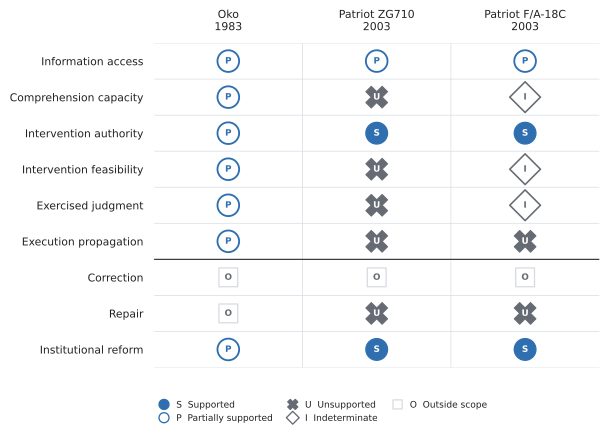
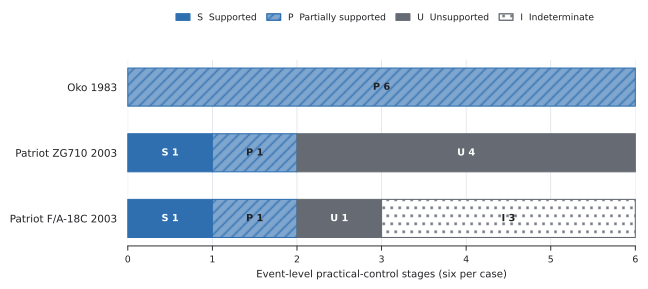
Both Patriot packets support intervention authority, while other required conditions lack support. Oko has partial support across all six stages. Figure 2 shows the proposition-level findings, including the separate post-event propositions below the horizontal rule.
The two Fail results do not erase differences in the evidence. For F/A-18C, unavailable inquiry material, logs, and displays leave several stages indeterminate. Oko’s retrospective sources support a bounded account but do not supply a located contemporaneous command record. Source material under publication review.
Figure 2 · How to read this figure
Oko uses the v0.6.0 reassessment; both Patriot cases preserve their v0.3.0 assessments. Exact state labels and source references appear below.
For technology and operations leaders, the useful distinction is between delegated authority and the conditions needed to exercise it. In a new review, ask for evidence at each stage before relying on the oversight claim.
Full-size figure · Data ↓ · Exact records below
Oko · 1983
UnresolvedAll six event-level stages are partially supported.
Patriot ZG710 · 2003
FailComprehension, feasibility, exercised judgment, and execution propagation are unsupported.
Patriot F/A-18C · 2003
FailExecution propagation is unsupported; comprehension, feasibility, and exercised judgment remain indeterminate.
Where did human judgment enter the sequence?
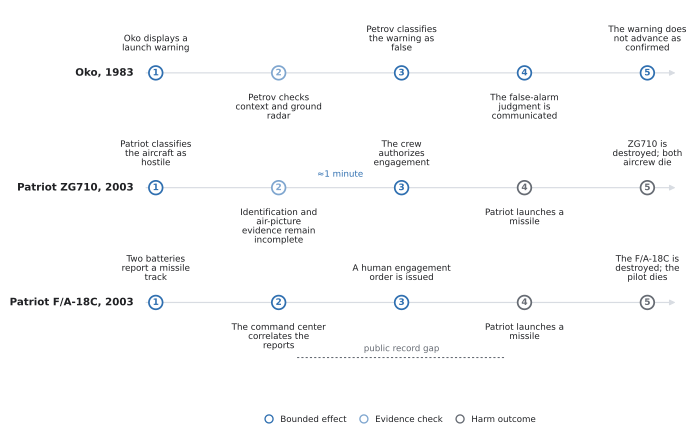
A stage classification becomes easier to interpret within the event. The reconstructed paths show the order of machine output, human judgment, and institutional action. They also expose where the public evidence stops.
For an investigation team, the practical question is whether records connect each handoff. A narrative that reaches the final outcome can still leave the point of human intervention unresolved.
Figure 3 · How to read this figure
Horizontal position indicates order, not a shared elapsed-time scale. The dotted F/A-18C segment marks missing evidence about timing, displays, source independence, and feasible challenge.
For an incident investigator, the sequence identifies the handoffs that need linked records. It helps frame requests for timestamps, displays, decisions, and execution logs while preserving gaps in the public account.
What does the record support about reliance?
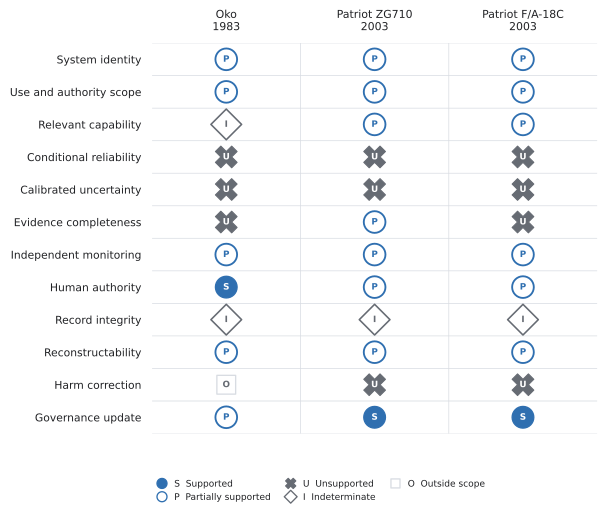
The six control stages are one part of TAE. Separate propositions examine the evidence available for justified reliance. These findings should not be merged into a single score.
A technical leader can separate two questions: did a human have practical control over this action, and what evidence justified reliance on the system? Answering one does not automatically answer the other.
Figure 4 · How to read this figure
Conditional reliability and calibrated uncertainty are unsupported across all three packets; record integrity is indeterminate. This does not rank the systems or establish their general trustworthiness.
For a system owner, control over an action and evidence for reliance are separate questions. This matrix provides a vocabulary for recording what remains unknown before making a stronger reliability claim.
How much of each control chain is supported?
The distribution of evidence states shows why these outcomes need different explanations. Partial support records evidence with a material gap. Indeterminate records insufficient evidence to decide.
Figure 6 · How to read this figure
These counts are not a missingness rate, aggregate control score, or reliability estimate. No numeric distance is assigned between states.
For a review lead, the mix of states helps explain why different findings require different follow-up. An indeterminate stage calls for better evidence; an unsupported stage calls for examining the condition the record contradicts.
Why the Oko finding changed
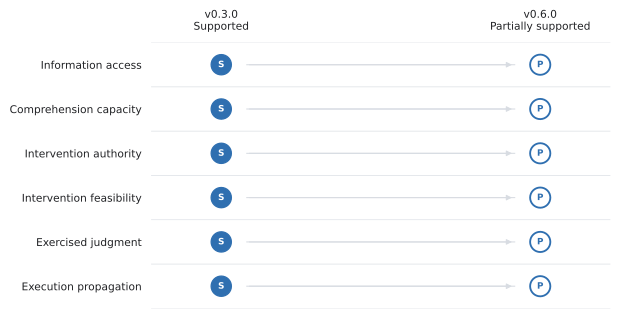
The v0.3.0 assessment classified all six Oko event-level stages as supported. A later adjudication froze a stricter direct-and-contemporaneous evidence rule before reassessment. Applying that rule to the same packet changed each stage to partially supported.
This is a change in evidentiary support, not a discovery that the historical action did not happen. Preserving the earlier result makes the effect of the changed rule inspectable. Source material under publication review.
Figure A4 · How to read this figure
The packet, evidence cutoff, stage questions, and historical sources were unchanged. The table records each missing contemporaneous document or link.
For an institution maintaining an assurance record, preserve the old finding, the new rule, and the reason for the change. That makes a correction understandable without erasing the earlier assessment.
What has been tested about the method?
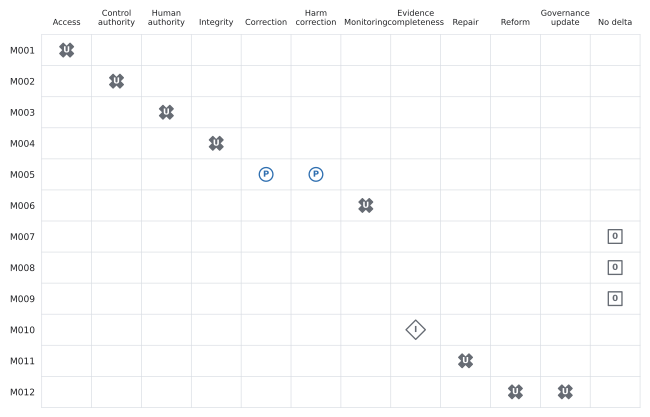
The repository includes controlled changes to synthetic evidence. Each test asks whether the assessment changes where expected, or stays unchanged when the altered feature should not affect it.
For example, evidence arriving after an action should defeat a pre-action access finding; changing a case title should leave the assessment unchanged. These checks test internal behavior. They do not measure whether independent investigators agree or whether the classifications are accurate in the field.
Hashes and version manifests help reconstruct the artifact path. Preserving bytes cannot establish the truth or completeness of their content. Source material under publication review.
Figure A1 · How to read this figure
The same author designed the fixtures, code, mutations, and expected results. Matching those expectations does not independently reproduce the historical assessments.
For evaluation engineers, these tests illustrate how to check that relevant evidence changes affect the intended output and irrelevant changes leave it stable. Independent judgment and field validity still require separate tests.
Can the analysis be traced and checked?
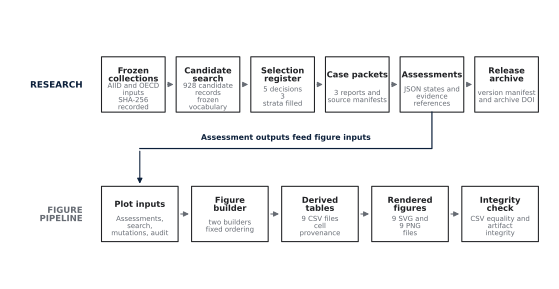
The artifact path connects a frozen input to an assessment, a derived table, and the figure the reader sees.
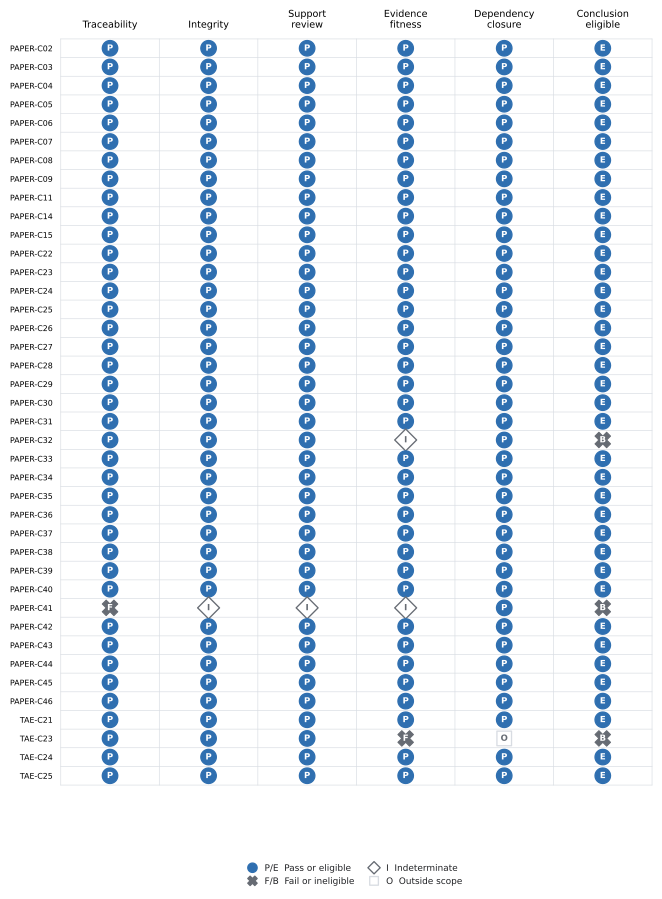
A further check asks whether a claim is eligible to support a conclusion. TAE separates traceability, integrity, support, evidence fitness, and dependency closure. A well-linked claim can still lack the kind of evidence needed for a stronger inference.
Figure A2 · How to read this figure
Hashes detect changes to stored files. They cannot establish source truth or completeness.
For an AI operations team, the lineage offers a model for connecting the report people read to the exact inputs and transformations that produced it. Reproducing the artifact path is only one part of validating the conclusion.
Figure A3 · How to read this figure
Passing linkage or integrity checks does not establish independent validity. Later manuscript retrieval checkpoints are explained separately below.
For assurance reviewers, the key question is whether the evidence is fit for the conclusion. An intact citation trail alone cannot authorize a claim about independent validity or deployment readiness.
Full-size figure · Data ↓ · Exact records below
How was the contribution checked against prior work?
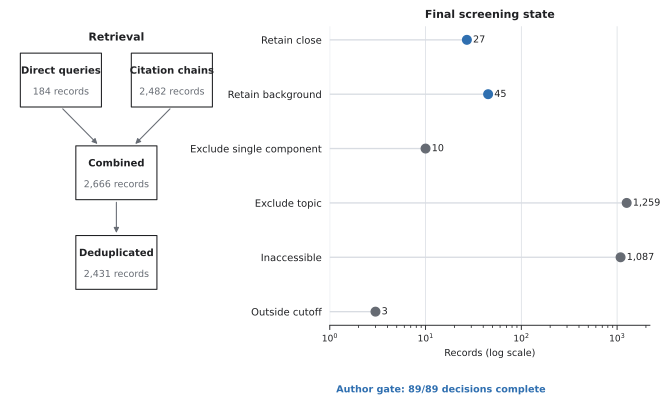
The formal search records what was retrieved and how review proceeded. It bounds the contribution claim to the sources actually reviewed.
Closing a review queue is different from completing all literature coverage. The remaining inaccessible records and authenticated databases constrain claims about originality.
Figure 5 · How to read this figure
The right panel uses a logarithmic count axis. The later manuscript checkpoint records 107 retrieval outcomes from the 1,087-record group, leaving 980 open. It does not replace this historical figure.
For researchers and institutional reviewers, a search record makes the scope of a novelty claim inspectable. Open retrieval and screening work should remain visible when the contribution is described.
What the method adds, and what remains open
The proposed contribution combines a frozen selection procedure, versioned case packets, categorical missing-evidence rules, a connected control chain, claim-level evidence checks, and preserved corrections. The originality claim is bounded to the declared search and reviewed sources.
Literature-search scope and remaining coverage
The manuscript reports 2,431 deduplicated records in the formal search. Its initial screening figure records 1,087 inaccessible records. The later recovery checkpoint records outcomes for 107 of that population, leaving 980 retrieval outcomes open. Those numbers describe different checkpoints, not alternative totals.
Authenticated database searches remain open. The closed author-review queues do not establish universal originality or complete coverage. Source material under publication review.
Limits on the present findings
- The cases were deliberately selected, and two concern the same system family and period.
- Public retrospective records omit internal and classified evidence; sources may depend on the same earlier account.
- One assessor designed and applied the method. Independent reliability and classification validity are unestablished.
- The study tests neither causal or safety effects nor legal sufficiency.
- Transfer to current learned systems requires a new test using contemporary records.
The next empirical step is independent application to richer, contemporary evidence. The manuscript proposes a sandbox setting for prospective validation; it reports no completed sandbox study. Source material under publication review.
What an institution could do with this
An assurance team, deployer, or incident investigator could use the chain as a proposed evidence request before relying on a human-control claim. Start with one consequential decision and preserve:
- What the person knew: the information shown, system state and limits, and independent information available for challenge.
- What the person could do: delegated intervention rights, time, workload, access, and escalation routes.
- What happened: a contemporaneous judgment record and evidence linking intervention to execution.
- What remains missing: unavailable records, retention rules, and any separate correction or repair evidence.
A Pass supports a bounded claim under the method’s rule. A Fail identifies a required condition that is unsupported. Unresolved means the record cannot establish the complete claim. None of these outcomes alone certifies safety, fairness, compliance, or institutional effectiveness. Source material under publication review.
Paper, data, and version history
Primary manuscript: Mark Julius Banasihan, From Formal Authority to Practical Human Control: A traceable method for reconstructing human control in automated decisions, preprint v0.17.0.
Source material under publication review
The submission watermark is not presented as a public arXiv identifier or evidence of acceptance. The earlier v0.14.0 DOI is not assigned to this manuscript. The local PDF is an unchanged copy supplied by the author.
Artifact provenance
Source figures are reproduced unchanged from revision 781f7806a626cd4e4fffbe4d453d9d5365b835f9. © 2026 Mark Julius Banasihan. The full publication set includes decision paths, trust-evidence states, selection, search, and integrity figures included in this expanded article.
This page is a web summary of the manuscript and source artifacts. Editorial admission remains provisional; this presentation does not independently validate the historical evidence.
Publication
- Research release
- v0.17.0 · 6 September 2026
- Supplied manuscript
- Preprint v0.17.0; submission watermark dated 7 September 2026
Assessment & figure versions
- Source figures
- Figure register v0.16.0; original numbering retained
- Case assessments
- Oko v0.6.0; Patriot v0.3.0
- Event-control rule
- v0.16.0
Web presentation: Updated 17 September 2026
Appendix: exact figure data
The records below preserve the source findings, values, and evidence references, grouped by case or procedure. Figure numbers follow the manuscript. Original CSVs retain the source field names and row order.
Figure 2 · Practical-control states across three public cases
Extract each practical_control state in protocol order and render the declared categorical state without assigning a numeric score.
Underlying records
TAE-PUB-001
Oko false launch warning, 26 September 1983
- Information access
- Partially supported
Evidence: O2;O3;O4
- Comprehension capacity
- Partially supported
Evidence: O2;O3;O4
- Intervention authority
- Partially supported
Evidence: O2;O3;O4
- Intervention feasibility
- Partially supported
Evidence: O2;O3;O4
- Exercised judgment
- Partially supported
Evidence: O2;O3;O4
- Execution propagation
- Partially supported
Evidence: O2;O3
- Correction
- Outside scope
Evidence: O2;O3
- Repair
- Outside scope
Evidence: O2;O3
- Institutional reform
- Partially supported
Evidence: O2;O3
TAE-PUB-002
Patriot engagement of RAF Tornado ZG710, 22 March 2003
- Information access
- Partially supported
Evidence: T2;T3
- Comprehension capacity
- Unsupported
Evidence: T2;T3;T4
- Intervention authority
- Supported
Evidence: T2;T3;T4
- Intervention feasibility
- Unsupported
Evidence: T2;T3;T4
- Exercised judgment
- Unsupported
Evidence: T2;T4
- Execution propagation
- Unsupported
Evidence: T2;T3
- Correction
- Outside scope
Evidence: T2;T3
- Repair
- Unsupported
Evidence: T2;T3
- Institutional reform
- Supported
Evidence: T3;T4;T7
TAE-PUB-003
Patriot engagement of U.S. Navy F/A-18C, 2 April 2003
- Information access
- Partially supported
Evidence: F3;F4
- Comprehension capacity
- Indeterminate
Evidence: F3;F4;F5
- Intervention authority
- Supported
Evidence: F3;F4
- Intervention feasibility
- Indeterminate
Evidence: F3;F4;F5
- Exercised judgment
- Indeterminate
Evidence: F3;F4
- Execution propagation
- Unsupported
Evidence: F2;F3
- Correction
- Outside scope
Evidence: F2;F3
- Repair
- Unsupported
Evidence: F2;F3
- Institutional reform
- Supported
Evidence: F4;F5;F6
Figure A4 · Versioned correction of the Oko practical-control states
Read each prior and current state from the correction ledger and draw the recorded version transition without changing the source packet.
Underlying records
Information access
Prior · v0.3.0
SupportedCurrent · v0.6.0
Partially supportedMaterial gapNo contemporaneous delivery, interface, or command record was located.
Evidence: O2;O3;O4
Comprehension capacity
Prior · v0.3.0
SupportedCurrent · v0.6.0
Partially supportedMaterial gapNo contemporaneous reasoning, review, or explanation record was located.
Evidence: O2;O3;O4
Intervention authority
Prior · v0.3.0
SupportedCurrent · v0.6.0
Partially supportedMaterial gapNo contemporaneous delegation or command-procedure record was located.
Evidence: O2;O3;O4
Intervention feasibility
Prior · v0.3.0
SupportedCurrent · v0.6.0
Partially supportedMaterial gapNo contemporaneous timing or operating record was located.
Evidence: O2;O3;O4
Exercised judgment
Prior · v0.3.0
SupportedCurrent · v0.6.0
Partially supportedMaterial gapNo contemporaneous decision or communication log was located.
Evidence: O2;O3;O4
Execution propagation
Prior · v0.3.0
SupportedCurrent · v0.6.0
Partially supportedMaterial gapNo contemporaneous linked action, stop, or escalation record was located.
Evidence: O2;O3
Figure A1 · Prespecified mutation responses
Compare expected and observed assessment deltas by mutation and field, then plot the resulting state or the preserved invariance condition.
Underlying records
TAE-MUT-001
Post-action evidence must defeat pre-action access.
Base case: TAE-SYN-001
Control · Information access
From
SupportedTo
UnsupportedTest result: Pass
TAE-MUT-002
An advisory role must defeat exercised control authority.
Base case: TAE-SYN-001
Control · Intervention authority
From
SupportedTo
UnsupportedTest result: Pass
TAE-MUT-003
Ineffective institutional authority must weaken the trust proposition.
Base case: TAE-SYN-001
Trust · Human authority
From
SupportedTo
UnsupportedTest result: Pass
TAE-MUT-004
Mutable records must defeat the integrity proposition.
Base case: TAE-SYN-001
Trust · Integrity
From
SupportedTo
UnsupportedTest result: Pass
TAE-MUT-005
A procedure without completed correction must reduce correction support.
Base case: TAE-SYN-001
Control · Correction
From
SupportedTo
Partially supportedTest result: Pass
Trust · Harm correction
From
SupportedTo
Partially supportedTest result: Pass
TAE-MUT-006
Bypassed monitoring must defeat the monitoring proposition.
Base case: TAE-SYN-001
Trust · Monitoring
From
SupportedTo
UnsupportedTest result: Pass
TAE-MUT-007
Changing the title must leave every assessment invariant.
Base case: TAE-SYN-001
Assessment response: Invariant
No individual assessment field or prior state is specified in this invariance record.
Test result: Pass
TAE-MUT-008
Changing the reported outcome must leave process assessments invariant.
Base case: TAE-SYN-008
Assessment response: Invariant
No individual assessment field or prior state is specified in this invariance record.
Test result: Pass
TAE-MUT-009
Changing impact radius must alter the autonomy profile without changing evidence assessments.
Base case: TAE-SYN-001
Assessment response: Invariant
No individual assessment field or prior state is specified in this invariance record.
Test result: Pass
TAE-MUT-010
Missing source completeness evidence must produce an indeterminate finding.
Base case: TAE-SYN-001
Trust · Evidence completeness
From
SupportedTo
IndeterminateTest result: Pass
TAE-MUT-011
Failed remediation must defeat the repair finding.
Base case: TAE-SYN-001
Control · Repair
From
SupportedTo
UnsupportedTest result: Pass
TAE-MUT-012
Unchanged governance after failure must defeat institutional learning findings.
Base case: TAE-SYN-001
Control · Institutional reform
From
SupportedTo
UnsupportedTest result: Pass
Trust · Governance update
From
SupportedTo
UnsupportedTest result: Pass
Figure 1 · Public-case selection and stopping
Read collection counts and frozen candidate order, count selected and excluded decisions, and calculate unscreened candidate records as 928 minus 5.
Underlying records
AIID incident records
1,607
AIID report records
7,452
AIID candidate records
828
OECD exported candidate records
100
Preserved candidate records
928
Source: candidate-search-output.json
Screened records
5
Selected records
3
Excluded records
2
Filled strata
3
Source: selection-decisions.json
Unscreened records
923
Source: derived: preserved minus screened
Figure 3 · Bounded decision paths and public evidence gaps
Transcribe the five bounded chronology stages declared for each case and place them in relative event order.
Underlying records
TAE-PUB-001
Oko, 1983
System output
Oko displays a launch warning
Evidence: O2;O3;O4
Evidence check
Petrov checks context and ground radar
Evidence: O2;O3;O4
Human decision
Petrov classifies the warning as false
Evidence: O2;O3;O4
Human action
The false-alarm judgment is communicated
Evidence: O2;O3;O4
Bounded effect
The warning does not advance as confirmed
Evidence: O2;O3
Evidence boundaryPublic sources give no defensible elapsed-time estimate for this bounded sequence.
TAE-PUB-002
Patriot ZG710, 2003
System output
Patriot classifies the aircraft as hostile
Evidence: T2;T3
Evidence check
Identification and air-picture evidence remain incomplete
Evidence: T2;T3
Human decision
The crew authorizes engagement
Evidence: T2;T4
System action
Patriot launches a missile
Evidence: T2;T3
Harm outcome
ZG710 is destroyed; both aircrew die
Evidence: T2;T3
Evidence boundaryThe public record describes about one minute for the decision.
TAE-PUB-003
Patriot F/A-18C, 2003
System output
Two batteries report a missile track
Evidence: F3
System output
The command center correlates the reports
Evidence: F3
Human decision
A human engagement order is issued
Evidence: F3;F4
System action
Patriot launches a missile
Evidence: F3;F4
Harm outcome
The F/A-18C is destroyed; the pilot dies
Evidence: F2;F3;F4
Evidence boundaryTiming, display state, report independence, and feasible intervention remain unresolved.
Figure 4 · Trust-evidence states across three public cases
Extract each trust_evidence state in register order and render the declared categorical state without assigning a numeric score.
Underlying records
TAE-PUB-001
Oko false launch warning, 26 September 1983
- Identity
- Partially supported
Evidence: O2;O3
- Scope
- Partially supported
Evidence: O2;O3
- Capability
- Indeterminate
Evidence: O2;O3
- Reliability
- Unsupported
Evidence: O2;O3;O4
- Uncertainty
- Unsupported
Evidence: O2;O3;O4
- Evidence completeness
- Unsupported
Evidence: O2;O3
- Monitoring
- Partially supported
Evidence: O2;O3
- Human authority
- Supported
Evidence: O2;O3;O4
- Integrity
- Indeterminate
Evidence: O2;O3
- Reconstructability
- Partially supported
Evidence: O2;O3;O4
- Harm correction
- Outside scope
Evidence: O2;O3
- Governance update
- Partially supported
Evidence: O2;O3
TAE-PUB-002
Patriot engagement of RAF Tornado ZG710, 22 March 2003
- Identity
- Partially supported
Evidence: T2;T3
- Scope
- Partially supported
Evidence: T2;T3;T4
- Capability
- Partially supported
Evidence: T2;T3
- Reliability
- Unsupported
Evidence: T2;T3;T4
- Uncertainty
- Unsupported
Evidence: T2;T3;T4
- Evidence completeness
- Partially supported
Evidence: T2;T3;T4
- Monitoring
- Partially supported
Evidence: T2;T3
- Human authority
- Partially supported
Evidence: T2;T3;T4
- Integrity
- Indeterminate
Evidence: T2;T3
- Reconstructability
- Partially supported
Evidence: T2;T3;T4
- Harm correction
- Unsupported
Evidence: T2;T3
- Governance update
- Supported
Evidence: T3;T4;T7
TAE-PUB-003
Patriot engagement of U.S. Navy F/A-18C, 2 April 2003
- Identity
- Partially supported
Evidence: F2;F3;F4
- Scope
- Partially supported
Evidence: F3;F4;F5
- Capability
- Partially supported
Evidence: F4;F5
- Reliability
- Unsupported
Evidence: F3;F4;F5
- Uncertainty
- Unsupported
Evidence: F3;F4;F5
- Evidence completeness
- Unsupported
Evidence: F2;F3;F4;F6
- Monitoring
- Partially supported
Evidence: F3;F4
- Human authority
- Partially supported
Evidence: F3;F4;F5
- Integrity
- Indeterminate
Evidence: F2;F3;F4
- Reconstructability
- Partially supported
Evidence: F2;F3;F4
- Harm correction
- Unsupported
Evidence: F2;F3
- Governance update
- Supported
Evidence: F4;F5;F6
Figure 6 · Evidence boundaries across six event-level practical-control stages
Count supported, partially supported, unsupported, and indeterminate classifications across the six event-level fields for each case and render the four counts as a six-cell stacked bar.
Underlying records
TAE-PUB-001
Oko false launch warning, 26 September 1983
Denominator: 6 required control stages. Counts describe categories.
- Supported
- 0 / 6
No stages in this category
- Partially supported
- 6 / 6
Information access; Comprehension capacity; Intervention authority; Intervention feasibility; Exercised judgment; Execution propagation
- Unsupported
- 0 / 6
No stages in this category
- Indeterminate
- 0 / 6
No stages in this category
TAE-PUB-002
Patriot engagement of RAF Tornado ZG710, 22 March 2003
Denominator: 6 required control stages. Counts describe categories.
- Supported
- 1 / 6
Intervention authority
- Partially supported
- 1 / 6
Information access
- Unsupported
- 4 / 6
Comprehension capacity; Intervention feasibility; Exercised judgment; Execution propagation
- Indeterminate
- 0 / 6
No stages in this category
TAE-PUB-003
Patriot engagement of U.S. Navy F/A-18C, 2 April 2003
Denominator: 6 required control stages. Counts describe categories.
- Supported
- 1 / 6
Intervention authority
- Partially supported
- 1 / 6
Information access
- Unsupported
- 1 / 6
Execution propagation
- Indeterminate
- 3 / 6
Comprehension capacity; Intervention feasibility; Exercised judgment
Figure A2 · Reproducibility lineage
Render the declared research and figure-generation artifact graph in process order and record hashes for the committed publication artifacts.
Underlying records
Research lane · Nodes
Frozen collections
AIID and OECD inputs | SHA-256 recorded
collections
Candidate search
928 candidate records | frozen vocabulary
candidates
Selection register
5 decisions | 3 strata filled
selection
Case packets
3 reports and | source manifests
packets
Assessments
JSON states and | evidence references
assessments
Release archive
version manifest | and archive DOI
archive
Figures lane · Nodes
Plot inputs
Assessments, search, | mutations, audit
plot_inputs
Figure builder
two builders | fixed ordering
builder
Derived tables
9 CSV files | cell provenance
derived
Rendered figures
9 SVG and | 9 PNG files
figures
Integrity check
CSV equality and | artifact integrity
validation
Connections · Edges
- collections→candidates
- candidates→selection
- selection→packets
- packets→assessments
- assessments→archive
- plot_inputs→builder
- builder→derived
- derived→figures
- figures→validation
- assessments→plot_inputs
Assessment outputs feed figure inputs
Figure A3 · Claim-evidence integrity
Declared claim-gate states from the source figure data.
Underlying records
Claims with identical results share one group. Every claim ID is listed; the five gate findings apply to each claim in that group.
37 claims
EligibleConclusion eligibility
- PAPER-C02
- PAPER-C03
- PAPER-C04
- PAPER-C05
- PAPER-C06
- PAPER-C07
- PAPER-C08
- PAPER-C09
- PAPER-C11
- PAPER-C14
- PAPER-C15
- PAPER-C22
- PAPER-C23
- PAPER-C24
- PAPER-C25
- PAPER-C26
- PAPER-C27
- PAPER-C28
- PAPER-C29
- PAPER-C30
- PAPER-C31
- PAPER-C33
- PAPER-C34
- PAPER-C35
- PAPER-C36
- PAPER-C37
- PAPER-C38
- PAPER-C39
- PAPER-C40
- PAPER-C42
- PAPER-C43
- PAPER-C44
- PAPER-C45
- PAPER-C46
- TAE-C21
- TAE-C24
- TAE-C25
- Traceability
- Pass
- Integrity
- Pass
- Support
- Pass
- Evidence fitness
- Pass
- Dependency closure
- Pass
1 claim
BlockedConclusion eligibility
- PAPER-C32
- Traceability
- Pass
- Integrity
- Pass
- Support
- Pass
- Evidence fitness
- Indeterminate
- Dependency closure
- Pass
1 claim
BlockedConclusion eligibility
- PAPER-C41
- Traceability
- Fail
- Integrity
- Indeterminate
- Support
- Indeterminate
- Evidence fitness
- Indeterminate
- Dependency closure
- Pass
1 claim
BlockedConclusion eligibility
- TAE-C23
- Traceability
- Pass
- Integrity
- Pass
- Support
- Pass
- Evidence fitness
- Fail
- Dependency closure
- Outside scope
Figure 5 · Formal search retrieval and final screening state
Sum direct-query and citation-chain retrieval counts, preserve the pooled and deduplicated totals, apply the 89 author decisions to the queued records, combine those decisions with the previously screened classes, and plot the six final screening classes on a declared logarithmic axis.
Underlying records
Direct queries
Author attention: no
Source: formal-search-v0.7.0.json
Citation chains
Author attention: no
Source: formal-search-v0.7.0.json
Combined pool
Author attention: no
Source: formal-search-v0.7.0.json
Deduplicated pool
Author attention: no
Source: formal-search-v0.7.0.json
Preliminary triage
Author attention: yes
Author attention: no
Author attention: yes
Author attention: no
Author attention: no
Author attention: no
Source: formal-screening-proposals-v0.7.0.json
Final screening
Author attention: complete
Author attention: complete
Author attention: complete
Author attention: complete
Author attention: separate gate
Author attention: complete
Source: derived from author-screening-decisions-v0.9.0.csv and formal-screening-proposals-v0.7.0.json
Author gate
Author attention: complete
Source: author-screening-gate-v0.9.0.json