Regulated Gate Decision Support
Availability: Open source. The reference implementation and illustrative records are available. Completed deployment effectiveness is not established. Status record · 2026-09-15
- The research question.
Can a team reconstruct why it proceeded, stopped, or waited at a consequential decision point?
- The contribution.
RGDS records the alternatives, evidence gaps, accepted risks, human authority, and conditions attached to a phase-gate decision. Its biopharma examples make those obligations inspectable in a structured record.
- Current evidence.
Six illustrative records pass strict validation, and nine regression tests pass in the local review. The related AI Assistance Governance profile proposes a separate assessment of the non-AI decision basis. The earlier study contains exploratory analysis and projections; institutional benefits remain unmeasured.
- Research materials.
Complete worked record ↓ · Ten-question study · Canonical Registry entry
Three related works, three kinds of evidence
RGDS makes a phase-gate decision the unit of documentation. A phase gate is a point at which an authorized team decides whether work can proceed, must stop, or needs more evidence. The proposed institutional value is the ability to recover the reasons and obligations later.
The core repository provides executable record validation. The AI-governance repository defines a working participation profile. The independent study is the author’s historical research and modeling, not an independent evaluation of either implementation.
GDI provides the broader decision-record architecture. RGDS supplies the regulated biopharma reference setting; this conceptual relationship does not establish conformance between their different schemas.
RGDS core
Decision schema, semantic validators, six illustrative records
AI Assistance Governance
Six covenants and a two-part AI Dependency Test
RGDS Independent Study
Ten research questions, literature synthesis, and modeled benefits
The study DOI belongs to the study. It is not an identifier for the core implementation or participation profile. Study date metadata differs across repositories; details appear below.
What is in the six-record example set?
Four examples record a conditional go, one a no-go, and one a deferral pending required evidence. These are authored illustrations, not six observed institutional deployments.
The set demonstrates how different decisions retain a question, rationale, alternatives, evidence, and named responsibilities. A conditional go adds obligations; a stop or deferral also leaves a record that can be revisited.
The schema supports five outcomes. The supplied canonical set contains no plain go or plain defer example. RGDS uses “defer with required evidence”; escalation is a governance action, not a permitted outcome value in this contract.
| Record | Illustrative setting | Recorded outcome | Conditions |
|---|---|---|---|
| RGDS-DEC-0001 | Data readiness | conditional go | 2 |
| RGDS-DEC-0002 | Readiness refusal | no go | 0 |
| RGDS-DEC-0003 | Missing required evidence | defer with required evidence | 2 |
| RGDS-DEC-0004 | Regulatory interaction | conditional go | 2 |
| RGDS-DEC-0005 | Drafting and publishing locks | conditional go | 3 |
| RGDS-DEC-0006 | AI-assisted readiness | conditional go | 2 |
Table 1. All six supplied example records. The outcome labels are source assertions, not Node & Norm approvals.
“Complete” needs a defined scope
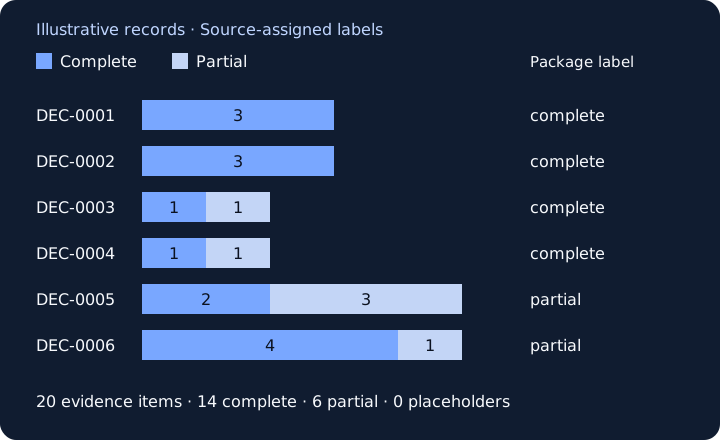
The six records contain 20 evidence items: 14 labeled complete and six partial. The figure preserves the author’s classifications. Completeness describes a record’s stated evidence state; it does not certify accuracy, quality, or adequacy for a decision.
Package labels and item labels also differ. DEC-0003 and DEC-0004 call the package complete while each contains one partial item. DEC-0002 is labeled complete but records a no-go rationale citing traceability and integrity failures.
A reviewer needs to reconcile those labels with the decision’s actual evidence requirements. The validator permits these combinations; it does not resolve their meaning.
Illustrative records · Source-assigned labels
- DEC-00013Package: complete
- DEC-00023Package: complete
- DEC-000311Package: complete
- DEC-000411Package: complete
- DEC-000523Package: partial
- DEC-000641Package: partial
20 evidence items · 14 complete · 6 partial · 0 placeholders
A conditional go keeps the unfinished work visible
DEC-0006 asks whether an illustrative non-clinical evidence package is ready for an Investigational New Drug submission. Its toxicity report awaits final sign-off, and longer-duration stability data is pending. The record chooses conditional go and describes the accepted uncertainty.
The example assigns two conditions to responsible roles and names the evidence needed to close them. Both follow-up actions are still marked open. That is useful for examining what remains owed after a decision is recorded.
This example demonstrates record structure. It does not establish that an actual submission could appropriately proceed with these evidence gaps or that either condition was fulfilled.
Finalize and submit the signed GLP tox report prior to IND filing.
- Responsible role
- Scientific adequacy owner
- Example due date
- 2026-01-05
- Evidence to close
- Final signed GLP tox report (controlled version) referenced in evidence registry.
Submit 3-month stability data amendment within 30 days post-IND filing, with cross-module linkage updated.
- Responsible role
- Manufacturing and stability readiness owner
- Example due date
- 2026-02-01
- Evidence to close
- 3-month stability dataset + updated Module 2 summaries and CMC tables reflecting the new data.
Conditions transcribed from RGDS-DEC-0006, dated 30 December 2025. Historical example dates are preserved, not presented as current deadlines.
Recorded follow-up
openDeliver final signed GLP tox report and update evidence registry reference for EVID-TOX-001.
openDeliver 3-month stability data amendment and update dependent Module 2 narratives/CMC tables.
What did the technical checks establish?
With the repository’s declared format-validation dependencies installed, all six examples pass strict schema and semantic validation. The nine regression tests also pass. They check invalid dates, missing review information, outcome constraints, and agreement between the two validation entry points.
Additional probes modified copies of DEC-0006. Removing its conditions or human-review entry still passed the schema alone, but failed semantic checks. Omitting AI confidence generated a warning that strict mode treated as failure.
For an operations team, this means the active validation mode and semantic rules matter. Passing the schema alone is a narrower result than passing the complete configured process.
| Controlled change | Schema alone | Strict schema + semantics |
|---|---|---|
| Original record | Pass | Pass |
| Delete AI disclosure | Fail | Fail |
| Set AI use to false | Pass | Fail |
| Remove human review | Pass | Fail |
| Remove conditions | Pass | Fail |
| Omit AI confidence | Pass | Fail |
Table 3. Local review, 13 September 2026. Strict mode treats warnings as failures. Source records were not modified.
Six-example results ↓ · Nine regression tests ↓ · Probe details and environment ↓
Keep AI assistance visible and bounded
Three of the six core examples disclose AI use. The associated profile requires explicit invocation, review and rejection, human risk acceptance, and traceable non-AI support for material reasoning. It prohibits AI from deciding, approving, accepting risk, or initiating downstream action under this profile.
These are adoption requirements. Documentation and validation do not implement runtime controls or authenticate the named people. DEC-0006 records one AI consistency-scan artifact with an edited disposition and a human-review entry; it supplies no observed review session.
Deleting the disclosure object fails schema validation. Setting AI use to false while leaving its artifacts passes structural validation but produces an inconsistency warning. A record can retain valid shape while misrepresenting history.
- No autonomous action
- Where decision and execution authority remain human-controlled
- Human authority and assessed independence
- Owner, approvers, and the non-AI decision basis
- Explicit invocation
- The bounded task and disclosed AI contribution
- Review and rejection
- Who accepted, edited, or rejected the output
- Explicit risk acceptance
- Uncertainty, dissent, and residual risk accepted by people
- Evidence subordination
- Sources supporting each material rationale claim
Can the reasoning stand without model output?
The AI Dependency Test asks whether material decision claims can be reconstructed from inspectable non-AI sources. Part A checks the original record’s structure. Part B requires a qualified reviewer to connect each claim to a source and explain the reasoning.
AI contributions remain disclosed in the original record. Excluding them from evidentiary support creates a separate assessment view; it does not authorize deleting historical AI use or rewriting it as unused.
The profile’s hypothetical narrative has a structural result of “not assessed” and a substantive result of “indeterminate” because no source packet or qualified assessment is available. This review has not performed Part B on the six core examples.
A valid record can have an unsupported basis.
Working assessment procedure · No field validation established.
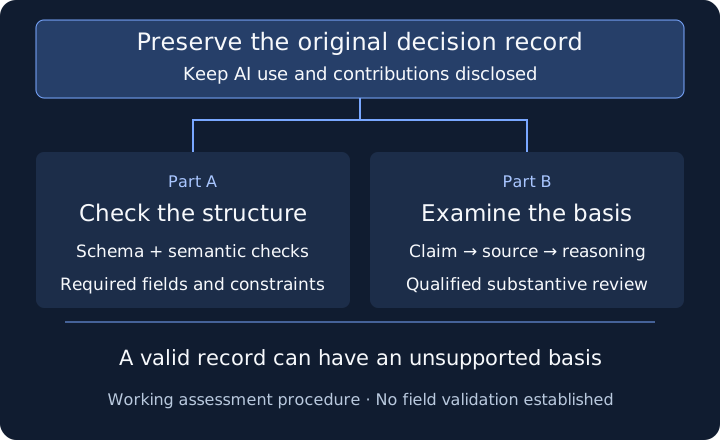
Complete procedure and result definitions · Hypothetical narrative and stated limits
The profile narrative’s “0003” identifier is historical and local. It is not the core repository’s DEC-0003 JSON example. The older “AI Removability Proof” has been superseded by this procedure.
How should the earlier study be read?
The study organizes ten questions around decision reconstruction, AI accountability, implementation, and proposed institutional benefits. Its documented research period is November 2025 through January 2026. It describes literature synthesis and AI-assisted research with author review.
Its time savings, financial returns, and regulatory effects are modeled or argued from external sources. They are not observed RGDS deployment results. “Independent study” identifies the research work; it does not mean independent validation of the author’s framework.
The newer core and profile repositories explicitly leave field effectiveness open. The website preserves the study as research history while using those narrower boundaries for current claims.
- 1–3: reconstruction, accountability, integration
- Proposed mechanisms and record requirements
- 4–6: deficiencies, decision velocity, alignment
- Attribution assumptions and effects requiring observation
- 7–8: value and implementation
- Modeled scenarios and proposed adoption plans
- 9–10: disclosure and regulatory trajectory
- Historical interpretations and forecasts, not current legal requirements
Read the complete study · Research workflow and AI disclosure
The study reports a 96-entry bibliography. That is a source count, not a participant sample or a set of independent RGDS evaluations. Its bibliography was not independently re-audited in this page review.
A time-saving model is a testable assumption
Question 7 illustrates decision-cycle reduction using a 45-day baseline and a proposed 22-day cycle. Applied to 15 decisions, the difference sums to 345 decision-days. This is arithmetic on assumed inputs.
Those days do not establish 345 calendar days of portfolio acceleration. Decisions can overlap, waiting time differs from staff effort, and improvements may not move a program’s completion date. Monetizing the sum also requires evidence about utilization, cost, and attribution.
The study’s financial and deficiency estimates require further reconciliation before reuse in an institutional business case. The page presents this calculation as a research assumption to test, without converting it into a demonstrated benefit.
summed decision-days, modeled
- 45 days per decision
- Study baseline assumption
- 22 days per decision
- Proposed RGDS scenario
- 15 decisions
- Five programs × three gates in the scenario
- 345 decision-days
- Recomputed arithmetic; no observed portfolio saving
What would demonstrate institutional usefulness?
The core evaluation plan is prospective. It asks whether records improve decision readiness, retrieval, time-to-decision, evidence quality, and governance execution. No completed deployment study is reported.
A useful next study would give reviewers comparable decision-reconstruction tasks with and without the structured records. It would measure time, missing facts, errors, disagreement, and the evidence needed to close a condition. Faster retrieval matters only if the reconstructed account remains accurate.
Practical authority requires its own assessment: could the responsible person reject a recommendation, stop an action, or make a correction take effect? That connects RGDS to TAE and HIT without transferring their findings to these examples.
- Can a reviewer reconstruct the decision?
- Task results, factual omissions, time, and reviewer agreement
- Do conditions get closed?
- Closure evidence, accountable owners, and observed follow-through
- Does AI assistance retain a non-AI basis?
- Qualified Part B assessment against the original source packet
- Does authority affect action?
- Observed intervention, timing, rejection, and correction
- Do outcomes improve?
- A comparative field study with defined institutional outcomes
Prospective evaluation plan · TAE · HIT · GDI
Sources, versions, and remaining checks
The core and profile were supplied as ZIP files. The study source snapshot was retrieved from its public repository on 13 September 2026. Archive hashes identify the inspected material; ZIP snapshots do not establish a checked-out Git commit.
- RGDS reference implementation
- v2.0.1 · released 9 September 2026
- AI Assistance Governance
- v1.1.0 · released 10 September 2026; no DOI assigned
- Independent study
- v1.4 · DOI 10.5281/zenodo.20242004
- Study date discrepancy
- Study CITATION.cff says 9 January 2026; core citation references 16 May 2026 for that study. Not normalized to one date.
- Local review
- 13 September 2026; six strict examples, nine regression tests, six probes, and profile documentation checks
The profile documentation check passed 50 local links and 17 inventory files. Its separate pinned-Git contract check was not run because the supplied ZIP has no Git history. No full-family conformance, substantive dependency assessment, regulator acceptance, or field validation is claimed.
Source artifacts remain unchanged under their supplied Apache-2.0 licenses. New figures and count tables are identified as explanatory or derived. Source narratives and example assertions remain attributable to their authors.
Core citation · Profile citation · Study citation · Core corrections · Profile corrections · Source manifest and archive hashes ↓ · Core license · Core notice · Profile notice · Study license