Research note
Can independent reviewers assess human influence consistently?
Research status: Research in progress. The earlier bounded application remains available; broader research and validation continue. Status record · 2026-09-15
- Human Influence Telemetry.
HIT is a documentary assurance method for assessing whether human authority had practical force in an institutional decision process. This note explains its first bounded independent application.
- What the study found.
Two independent scorers assigned the same categories to all seven items in one frozen Cigna PxDx packet. The predeclared advancement gate was met without substantive adjudication.
- What that means.
The exercise establishes agreement for this packet under scorer contract 0.1.0. It does not establish broad reliability, evidence truth, effective oversight, or lower harm. Replication under the current contract remains open.
- Source materials.
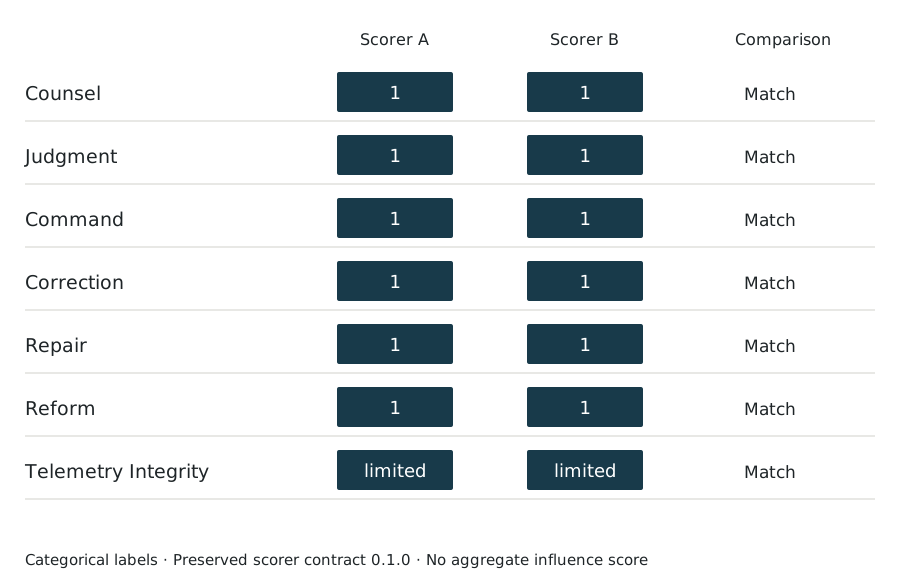
Seven matching findings on one case
Both scorers assigned category 1 to Counsel, Judgment, Command, Correction, Repair, and Reform, and limited to Telemetry Integrity.
Under the preserved handbook, category 1 means the form of oversight was present but the records did not show practical capacity to alter the decision path. Agreement therefore does not mean the process received a favorable oversight assessment.
For an institutional reader, the result answers a narrower question: could two reviewers apply these categories to this same record and reach the same output? The answer in this exercise was yes.
- Exact agreements
- 7 / 7
- Reviewers
- 2
- Frozen packet
- 1
| Assessment item | Scorer A | Scorer B |
|---|---|---|
| Counsel | ||
| Judgment | ||
| Command | ||
| Correction | ||
| Repair | ||
| Reform | ||
| Telemetry Integrity |
Exact data CSV ↓ · Earlier figure presentation
- 0
- Absent
- 1
- Present but ceremonial
- 2
- Substantively exercised
- IE
- Insufficient evidence
Category labels are not percentages. Telemetry Integrity is assessed separately. No aggregate influence score is calculated.
What did human review contribute?
A signature or review step records human involvement. HIT asks what the available evidence supports about the person’s actual contribution and the institution’s capacity to correct, repair, and change its process.
For a technology or operations leader, the practical starting point is a bounded workflow: what records would let a second reviewer reconstruct the human role? The dimensions alongside translate that question into evidence requests.
These are proposed uses of the method. This study does not measure the benefit of introducing HIT into an institution.
- Counsel
- Information and evidence available to the reviewer
- Judgment
- Reasons, alternatives, dissent, and deliberation
- Command
- Authority to approve, reject, modify, or stop
- Correction
- Appeal, escalation, interruption, and reversal
- Repair
- Remediation, corrected decisions, and responsibility for repair
- Reform
- Changes to rules, systems, or institutional practice
- Telemetry Integrity
- Provenance, completeness, edit control, and retention
What exactly was assessed?
The exercise examined the described post-service PxDx claims-review workflow and the role of medical directors or physician reviewers. It used a fixed public record, rather than a representative sample of claim files.
The packet combines reporting, an institutional response, and a pleading-stage court order. Those sources have different evidentiary roles. An allegation or procedural ruling is not treated as a final merits finding.
For an institution designing a similar review, fixing the period, process, and source packet lets readers understand what the findings cover and what additional records could change them.
- Packet
- HIT-IR-CIGNA-PXDX-001
- Period
- Reported 2022 activity through 31 March 2025
- Sources
- Investigative report; follow-up report; federal pleading-stage order
- Scorers
- Two eligible independent reviewers
- Scorer contract
- 0.1.0
- Protocol
- HIT-IRP-CIGNA-001 · 1.0.0
- Comparison
- Six substantive findings plus Telemetry Integrity
How was independence preserved?
The protocol fixed the packet, submission requirements, comparison rule, and advancement threshold before scoring. Each scorer submitted findings separately.
The adjudication record reports independence attestations, access to all three sources, preserved manual submissions, and scorer confirmation of the JSON transcriptions. It also records that neither scorer changed a finding after seeing the other submission.
These are recorded attestations and preservation checks. This page has not independently investigated scorer eligibility. For an evaluation team, their value is an inspectable account of how the result was produced.
- FreezeDefine packet, rules, and advancement threshold.
- AssessObtain independent findings and rationales.
- PreserveVerify transcriptions and lock the submitted records.
- CompareCalculate agreement before adjudication.
- InterpretKeep the result attached to its original contract.
What does seven out of seven establish?
The predeclared gate required at least six exact agreements across seven items and zero critical disagreements. The observed result was seven agreements and zero critical disagreements.
The simple agreement proportion is the number of matching items divided by the total compared. Seven dimensions are not seven independent cases; the sample still contains one packet and two scorers.
Cohen’s kappa is not estimable here because all six substantive ratings occupied the same category. Perfect observed agreement therefore supplies no general chance-corrected reliability estimate.
This result supported the repository’s Level 2 / Applicable maturity decision. That designation remains bounded to the exercise; it is not a deployment certification.
Predeclared advancement rule
Required
6 / 7 or more exact matches
0 critical disagreements
Observed
7 / 7 exact matches
0 critical disagreements
The predeclared gate was met.
Substantive Cohen’s kappa: not estimable. All six substantive ratings occupy one category.
Matching categories can have different reasoning
Scorer A cited S1 for all seven findings; Scorer B cited S2 for all seven. The adjudication record notes differences in their analytical vocabulary as well. Those differences did not produce a categorical disagreement.
For an assurance reviewer, this is a reason to preserve rationales alongside categories. A matching output alone does not reveal whether reviewers relied on the same evidence or made the same interpretive steps.
No substantive adjudication was required. The original findings remain the primary result.
Scorer A
Source S1
Referenced for all seven findings.
Scorer B
Source S2
Referenced for all seven findings.
The categories match. The source references and reasoning remain separate records.
A traceable claim can still lack adequate evidence
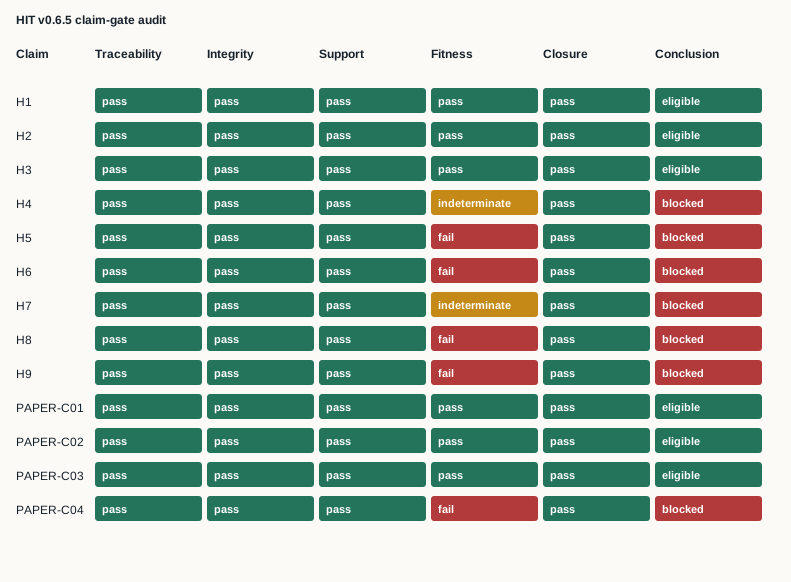
The repository’s v0.6.5 audit records five checks: traceability, integrity, human support review, evidence fitness, and dependency closure. The figure groups the evidence-fitness findings and preserves the results for the other four checks.
For example, H3 concerns the completed frozen-packet exercise. H5 proposes that higher HIT findings predict lower harm or better repair; the claim map marks it blocked because an outcome study is absent.
For a technology leader, this distinction prevents a working implementation or well-documented result from being used as evidence for a stronger claim it never tested. The figure reports the repository’s own audit state, not an independent validation of the method.
Evidence fitness · 13 mapped claims
- Pass
- 6 claims
- Fail
- 5 claims
- Indeterminate
- 2 claims
- Traceability
- 13 / 13 pass
- Integrity
- 13 / 13 pass
- Human support review
- 13 / 13 pass
- Dependency closure
- 13 / 13 pass
6 of 13 claims are eligible for a conclusion in the source audit.
Source CSV ↓ · Unchanged source figure · All 13 claims below
What needs to be tested next?
The supplied repository stages a separate current-contract replication. It proposes three reviewers each assessing three frozen packets using the 0.4.0 specification.
The plan compares eight non-derived items per packet, including separate institutional-record and assessment-packet integrity statuses. It is not a rerun of the seven-item historical contract.
Protocol and packet freezing remain prerequisites. Candidate materials do not establish a new completed result or advance maturity. For teams considering HIT, current-contract reproducibility and transfer to their own evidence conditions remain open questions.
Preserved historical exercise
- Scorer contract · 0.1.0
- The rules used for the seven-item comparison.
- Human result · 0.6.0
- Released 18 July 2026.
- Repository citation · 0.6.5
- Released 9 August 2026.
Current specification and implementation
- Normative specification · 0.4.0
- A separate contract from the historical result.
- Conformance engine · 0.5.0
- The implementation layer.
Proposed replication
- 0.7.0 candidate
- Three reviewers × three frozen packets proposed. Not locked; scoring prohibited before lock.
Claim-by-claim evidence record
Each entry preserves the source claim, its status, evidence-fitness result, and eligibility to enter a conclusion. All thirteen claims are visible here; the source JSON retains the longer rationales and evidence locators.
The scorer ratings appear in Figure 1 above. These records describe a documentary method and one application. They do not establish legal correctness, evidence truth, causal effectiveness, institutional adoption, or a validated aggregate influence score.
- H1Supported
HIT represents six substantive dimensions and split Telemetry Integrity in a machine-readable assessment.
Conclusion eligible: Yes · Evidence fitness: pass
- H2Supported
The evidence-state and finding rules distinguish affirmative absence, ceremonial presence, substantive exercise, and insufficient evidence in the executable boundary suite.
Conclusion eligible: Yes · Evidence fitness: pass
- H3Supported
Two eligible independent reviewers reached the predeclared threshold on one frozen Cigna packet under the preserved 0.1.0 scorer contract.
Conclusion eligible: Yes · Evidence fitness: pass
- H4Provisional
HIT can classify ceremonial oversight where a binary human-presence label would record human involvement.
Conclusion eligible: No · Evidence fitness: indeterminate
- H5Blocked
Higher HIT findings predict lower harm or better repair.
Conclusion eligible: No · Evidence fitness: fail
- H6Unsupported
A high HIT finding proves meaningful human control in a causal or legal sense.
Conclusion eligible: No · Evidence fitness: fail
- H7Provisional
HIT evidence may inform external oversight, accountability, and contestability analysis within a separately reviewed applicability boundary.
Conclusion eligible: No · Evidence fitness: indeterminate
- H8Blocked
HIT has been independently adopted by an institution outside the author's control.
Conclusion eligible: No · Evidence fitness: fail
- H9Pending
The public HIT package can be installed, operated, and explained without private author interpretation.
Conclusion eligible: No · Evidence fitness: fail
- PAPER-C01Supported
HIT is a documentary assurance method with a stable 0.4.0 normative contract and a separate 0.5.0 conformance engine.
Conclusion eligible: Yes · Evidence fitness: pass
- PAPER-C02Supported
The published human result is bounded to one frozen packet and does not resolve current-contract replication.
Conclusion eligible: Yes · Evidence fitness: pass
- PAPER-C03Supported
The v0.6.5 audit detects its prespecified corruptions and blocks mapped claims whose required gates do not pass.
Conclusion eligible: Yes · Evidence fitness: pass
- PAPER-C04Blocked
HIT has established population-wide inter-rater reliability under the current 0.4.0 contract.
Conclusion eligible: No · Evidence fitness: fail
Sources and version notes
This page was checked against the author-supplied human-influence-telemetry-main.zip on 11 September 2026. The archive’s citation identifies version 0.6.5. Its commit identity has not been inferred from the archive name.
The ZIP includes historical and unreleased entries; older references to 0.6.4 do not supersede the 0.6.5 citation. The human result remains 0.6.0. Candidate 0.7.0, 0.9.0, and 1.0.0 documents describe future work.
Archive SHA-256: e555c53784dc8966147330a1acebf63d6155aae874b4916bcbab5445e70814d2.
Citation metadata ↓ · Release history · Source license · Complete claim-evidence map
Source downloads remain unchanged copies. Figures 1 and 2 are Node & Norm presentations of the source findings and gate data; the original figure presentation remains linked. Archive inspection verifies transcription and provenance; research admission remains provisional.