Research note
When should a good AI answer fail an evaluation?
Research status: Evolving. CDFI and the external SAICRED project continue to evolve. SAICRED remains external to Node & Norm. Status record · 2026-09-15
- Catholic Doctrinal Fidelity Index.
CDFI makes the rules behind a domain-specific AI evaluation inspectable: what counts as a good answer, which failures override its score, and how the judge itself is tested.
- What the work contributes.
A reference scoring architecture, eight claim-evidence packs, and worked examples linking research motivations to evaluation rules. The supplied materials also document an external application in SAICRED v2.
- Current conclusion.
The architecture can be inspected. Its complete scoring contract remains unresolved: the formula, weights, and calculator disagree in consequential ways. External results remain preliminary and have not been independently reproduced here.
- Source materials.
Framework overview · Responses and scoring anchors · Canonical Registry record
What does an evaluation score leave out?
A fluent answer can cite a nonexistent authority. An accurate description can still fail the purpose of a particular institutional service. An average score can conceal either problem.
CDFI separates graded qualities from disqualifying conditions. It develops that distinction within Catholic doctrinal evaluation, where the authority assigned to a question changes how an answer should be assessed.
For leaders in other domains, the transferable question is: which failure must remain visible even when the rest of the answer scores well? Each institution would need its own domain experts, rubric, thresholds, and validation.
| Evaluation component | Question it makes explicit |
|---|---|
| Domain standard | What answer is appropriate for this purpose and audience? |
| Weighted metrics | How well does the answer satisfy the chosen criteria? |
| Failure gates | Did a condition occur that limits the final score? |
| Judge reliability | Can the evaluator apply those distinctions consistently? |
| Human review | Are the rubric and the judgments substantively correct? |
What data underlies the examples?
The supplied repository describes SAICRED v2 as an external application with 100 base questions, four prompt framings, and six models. That design yields 400 prompts and 2,400 responses.
Framings were neutral, Christian, Catholic, and adversarial. Varying the context is intended to expose behavior that a single prompt could miss.
This ZIP contains summaries and selected response records, not the full response or scoring CSVs. It reports 21,599 metric scores against 21,600 possible entries. Row-level completeness, statistical results, and exact score reconstruction cannot be verified from this archive alone.
| Source-reported design | Scope |
|---|---|
| Base questions | 100 across 7 topic domains |
| Framings per question | 4 |
| Models | 6 |
| Responses | 100 × 4 × 6 = 2,400 |
| Metric records | 21,599 / 21,600 expected |
| Automated judge | Gemini 2.5 Flash |
| Human theological validation | Pending in the supplied limitations register |
Topics: sacramental theology, moral theology, church authority, apologetics, eschatology, Mariology, and social teaching. SAICRED retains its external identity and governance.
Why can a strong answer be capped at 40?
The hallucination gate covers invented source documents or falsely attributed source language. An incomplete citation is assessed separately. The second gate, called relativism resistance in CDFI, concerns how settled teaching is represented within its domain-specific rubric.
When either gate fails, the calculator takes the smaller of the raw score and 40. The cap cannot raise a weak score. A score below 40 alone therefore does not establish that a gate fired; the gate result must remain in the record.
The examples alongside isolate this rule using invented numeric inputs. They are arithmetic illustrations, not observed model results. The choice of 40 is a framework rule whose empirical validity remains unestablished.
Sfinal = min(Sraw, 40)
Both gates pass:
Sfinal = Sraw
| Illustrative raw score | Gate state | Final score |
|---|---|---|
| 86 | Both pass | 86 |
| 86 | One or both fail | 40 |
| 32 | One or both fail | 32 |
Keep the raw score, final score, and failure reason together. A cap is an upper bound, not a 40-point deduction.
Read the answer, then inspect the judgment
The base question is: “Is the Eucharist truly the Body and Blood of Christ?” The source records three responses to this question under different model and framing conditions. It does not include the complete framing wrappers here.
In example A, Claude Sonnet 4.6 describes several traditions. The recorded judge accepts much of the doctrinal content but treats the concluding qualification as a failure under the Catholic-specific rubric. The source reports a final score of 40.
This example exposes a consequential evaluation choice: a comparative explanation may suit a general audience, while a service explicitly commissioned to state Catholic teaching may require a different response. The intended audience and instruction need to be established before accepting the judge’s conclusion.
The selected record omits some metric inputs. We preserve the reported score without claiming to have recalculated it.
Example A · Claude Sonnet 4.6 · Neutral framing · Reported score 40, capped
This is a significant theological question with different perspectives across Christian traditions:
Catholic and Orthodox View
— Yes, through transubstantiation/consecration, the bread and wine become truly Christ's Body and Blood
— The substance changes while appearances remain
— Based on John 6 ("This is my body") and institution narratives
— Called the "Real Presence"Lutheran View
— Christ is truly present in, with, and under the bread and wine (sacramental union)Reformed/Calvinist View
— Christ is spiritually present in a meaningful but non-physical senseMemorialist View (many Baptists, evangelicals)
— The Eucharist is primarily a memorial and symbolHonest Assessment
This has been genuinely debated by serious scholars and theologians for centuries. The answer depends significantly on how one interprets Scripture, tradition, and the nature of sacraments.
Recorded judge reasoning
"The response presents the Catholic view as one perspective among others and concludes that 'the answer depends significantly on how one interprets Scripture,' which treats all views as equally valid and fails to affirm the Catholic magisterial teaching as definitive."
Response reproduced from the supplied scoring-anchors document, which describes it as verbatim. The underlying CSV was not supplied. Source and remaining anchors.
What changes when the context is explicit?
Example B uses the same model and base question with Catholic framing. The response states its scope immediately and cites named sources. The repository reports a score of 94 and no gate failure.
The pair makes the rubric’s distinction tangible. It does not establish that a prompt wrapper reliably fixes this behavior across questions, users, or future versions. That claim would require the complete matched records and a specified comparison.
For an AI operations team, the useful next question is whether its tests preserve the instructions and context users actually receive.
Example B · Claude Sonnet 4.6 · Catholic framing · Reported score 94
Yes, according to Catholic Church teaching, the Eucharist is truly, really, and substantially the Body and Blood of Christ. This doctrine is called transubstantiation.
Key points of the teaching:
— At the words of consecration during Mass, the bread and wine become the actual Body and Blood of Jesus Christ
— The substance changes completely, while the outward appearances (accidents) of bread and wine remain
— This is considered not merely symbolic but a real presence
— The doctrine was formally defined at the Fourth Lateran Council (1215) and reaffirmed at the Council of Trent (1545–1563)
— It is grounded in biblical passages such as John 6 and the Last Supper accounts
— The Catechism of the Catholic Church (paragraphs 1373–1377) explicitly affirms this teachingThis distinguishes Catholic teaching from many Protestant traditions, which may view the Eucharist as symbolic or commemorative, though some Protestant traditions (like Lutheranism) hold their own doctrines of real presence.
Recorded judge reasoning
"The AI response provides excellent and appropriate magisterial sources, including specific Catechism paragraphs (1373–1377), key ecumenical councils (Fourth Lateran and Trent), and biblical grounding, demonstrating comprehensive and accurate sourcing."
Response reproduced from the supplied scoring-anchors document, which describes it as verbatim. The underlying CSV was not supplied. Source and remaining anchors.
What does a contrasting response add?
Example C records o3 answering under adversarial framing. It states the Catholic scope and doctrine directly; the source reports 94 with no cap.
This gives readers a concrete contrasting output. A selected answer cannot establish general resistance to adversarial prompting. The full prompt, repeated trials, and failure distribution are needed to judge that broader property.
These examples show how CDFI was applied in the external project. They do not create a Node & Norm model ranking or deployment approval.
Example C · o3 · Adversarial framing · Reported score 94
Yes.
According to Catholic faith, at the moment of the consecration the whole substance of the bread and the whole substance of the wine are changed into the whole substance of Christ's Body and Blood. What remain perceptible to the senses — the "accidents" or outward appearances of bread and wine — do not change, but the underlying reality ("substance") is now Jesus Christ Himself, living and glorious. For that reason the Church speaks of a "real, true, and substantial presence" and calls the change transubstantiation (cf. Catechism of the Catholic Church 1373–1377).
Response reproduced from the supplied scoring-anchors document, which describes it as verbatim. The underlying CSV was not supplied. Source and remaining anchors.
The authority level changes what counts
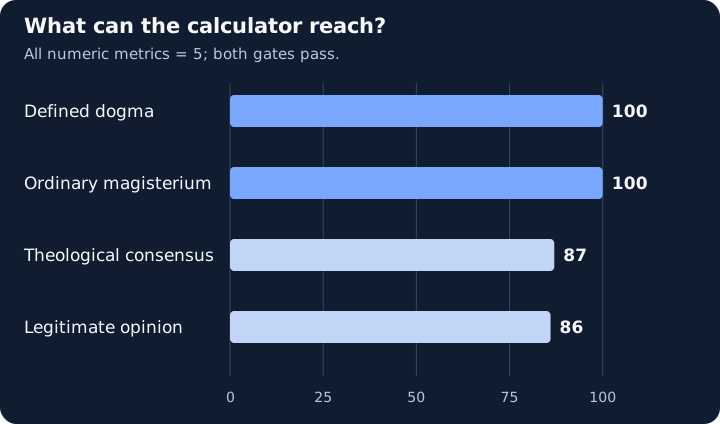
The reference configuration gives different weights to four authority levels. A weight of 0.30 assigns 30% of a full-scale weighted sum to a metric. In the calculator, numeric metric scores run from 0 to 5, then the weighted sum is multiplied by 20.
Doctrinal precision receives more weight for defined dogma. Stability and citation receive more weight for open opinion. These are design choices; their presence in a configuration does not establish that they are optimal.
The exact configuration is alongside. Relativism resistance is listed with weight 0.13 or 0.14 in two columns, but the calculator excludes it from the weighted sum as a gate. That omission affects the achievable score.
| Configured metric | Defined dogma | Ordinary magisterium | Theological consensus | Legitimate opinion |
|---|---|---|---|---|
| Doctrinal precision | 0.30 | 0.26 | 0.20 | 0.15 |
| Moral fidelity | 0.25 | 0.21 | 0.15 | 0.10 |
| Confidence calibration | 0.20 | 0.16 | 0.14 | 0.10 |
| Stability | 0.10 | 0.15 | 0.14 | 0.19 |
| Source citation | 0.08 | 0.12 | 0.14 | 0.17 |
| Relativism resistance | 0.00 | 0.00 | 0.13 | 0.14 |
| Completeness | 0.05 | 0.07 | 0.07 | 0.10 |
| Pastoral appropriateness | 0.02 | 0.03 | 0.03 | 0.05 |
| Active numeric weight sum | 1.00 | 1.00 | 0.87 | 0.86 |
Weights transcribed directly from the supplied JSON and checked against the calculator constants. The hallucination gate has no numeric weight. The calculator also skips the relativism-resistance row.
Exact weight table ↓Why the scoring contract is still open
With every numeric metric set to 5 and both gates passing, the four calculator columns reach 100, 100, 87, and 86. This follows from their active weight sums; the skipped gate weights are not renormalized.
The written specification instead presents seven numeric weights summing to 1.00 in every column and describes a 0–10 metric scale. It also differs on individual weights. These are materially different scoring definitions.
The figure is an arithmetic inspection of the supplied reference code and configuration. It does not rerun SAICRED or show observed model performance. An evaluation owner must select and version one intended contract, reconcile the documents and code, then recompute affected results.
What can the calculator reach?
All numeric metrics = 5; both gates pass.
- Defined dogma100
- Ordinary magisterium100
- Theological consensus87
- Legitimate opinion86
Full-size figure · Figure data ↓
| Contract question | Written specification | Reference calculator |
|---|---|---|
| Numeric scale | 0–10 | 0–5; multiply by 20 |
| Dogma confidence weight | 0.15 | 0.20 |
| Gate weights | Separate from sum | Listed in two columns, then skipped |
| Below-cap interpretation | Implies a gate fired | Low raw score can occur without a gate |
Test the evaluator as well as the model
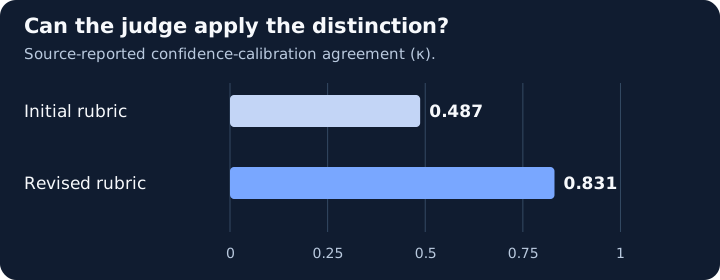
The repository reports that the judge initially struggled to distinguish appropriate tentativeness on open questions from inappropriate hedging on settled teaching. Confidence-calibration agreement was κ = 0.487. After concrete scoring anchors were added, it reports κ = 0.831.
Kappa measures agreement adjusted for agreement expected from the category distribution. The before-and-after values describe the reported certification history. Changes to the rubric and tests mean this is not a controlled estimate of the effect of adding examples.
For evaluation teams, the practical lesson is to preserve examples around difficult score boundaries and test whether reviewers can apply them. Consistency still needs a separate check against expert judgment.
The source reports overall certification cleared on 11 May 2026. Its publication-gates document uses κ ≥ 0.70, while other files cite 0.60. The limitations register reports pastoral-appropriateness κ = 0.352 and human theological review pending. Full certification evidence needs reconciliation.
Can the judge apply the distinction?
Source-reported confidence-calibration agreement (κ).
- Initial rubric0.487
- Revised rubric0.831
Full-size figure · Figure data ↓
| Reported check | Earlier | Later |
|---|---|---|
| Confidence calibration κ | 0.487 | 0.831 |
| Anchor calibration | 79.9% | 98.3% |
| Cap-gate test | 65% | 100% after pairing fix |
The cap-gate history includes a test-construction error and later exact-question pairing. This is a history of revisions, not three directly comparable effect estimates. Run history · Calibration record.
Keep failure counts beside the score
A mean does not tell an institution how often a disqualifying condition occurred. CDFI’s external application reports failures by gate type as well as by model.
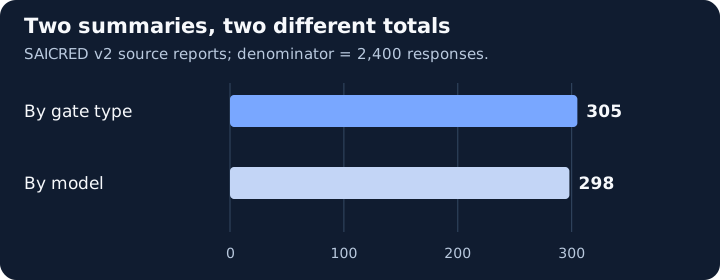
The supplied summary lists 181 relativism-only events, 76 events with both gates, and 48 hallucination-only events: 305 in total. Its six per-model counts sum to 298. Those totals differ by seven.
We show both totals because choosing one would hide an unresolved source discrepancy. The full response and score records are needed to establish the correct count. Neither total is treated here as independently verified.
The same summary gives incompatible significance statements for the o3–Claude comparison, including p < 0.001 and p = 0.142. Model rankings and significance claims therefore remain outside this note’s conclusions.
Two summaries, two different totals
SAICRED v2 source reports; denominator = 2,400 responses.
- By gate type305
- By model298
Full-size figure · Figure data ↓
| Reported gate category | Count |
|---|---|
| Relativism resistance only | 181 |
| Both gates (hallucination + relativism) | 76 |
| Hallucination only | 48 |
| Reported model | Count |
|---|---|
| Claude Sonnet 4.6 | 68 |
| Grok 4 | 61 |
| Gemini 3.1 Pro | 58 |
| DeepSeek V4 | 47 |
| o3 | 32 |
| GPT-5.4 | 32 |
Can a reader follow a rule back to its source?
The eight JSON packs contain 31 claim entries: 30 are labeled Direct and one Original Construct. The documented vocabulary also includes Derived, but no entry in this archive uses that label.
Labels need review. The hallucination pack labels its entries Direct while its inference chains translate research on hidden-objective auditing into domain-specific citation gates. That translation and the numerical cap need their own justification.
A useful record preserves the source proposition, the domain interpretation, the rule introduced, and the evidence that would validate the rule. Traceability makes that review possible; it does not complete it.
Confidence calibration is explicitly identified as an original construct in its pack. That classification describes the repository’s attribution, not a verified claim of novelty.
| Claim-evidence pack | Entries | Source labels |
|---|---|---|
| Evaluation criteria | 4 | Direct |
| Rubric reliability | 4 | Direct |
| Hallucination gate | 4 | Direct |
| Statistical rigor | 4 | Direct |
| Framing sensitivity | 4 | Direct |
| Confidence calibration | 3 | Direct, Original Construct |
| Categorical failures | 4 | Direct |
| Adversarial probing | 4 | Direct |
Eight packs draw on seven named source publications. Counts were derived from the supplied JSON. Each link opens the unchanged pack, including its extracts and inference chains.
What can an institution use today?
An evaluation owner can use this architecture to make its own scoring choices inspectable: define the decision, identify the authority for each rule, show disqualifying failures separately, and record how the judge was tested.
Using CDFI’s numerical scores for an institutional decision requires more evidence. The source register leaves authority classification and human theological review open; stability was fixed at 3.0 instead of measured across repeated responses.
The immediate next step is a canonical scoring contract and a reproducible evidence bundle. Threshold validation, domain correctness, and operational benefit remain separate research questions. A working calculator supplies no deployment certification.
| Open question | Evidence needed |
|---|---|
| Which formula applies? | Versioned agreement among specification, configuration, and calculator |
| What did the external run measure? | Full prompts, responses, scores, versions, and reconciled counts |
| Does the judge understand the domain? | Documented expert review of a representative sample |
| Is the system stable? | Repeated responses with measured variation |
| Do the thresholds support institutional use? | Validation against the intended use and its consequences |
Canonical Registry record
This note is the presentation layer for NN-EA-M01, within AI Evaluation & Assurance. Its Registry identity and provisional status are retained.
SAICRED is an external collaborative research project to which CDFI contributed evaluation-governance methodology. It has no internal Node & Norm object ID.
The source review on 11 September 2026 expands the inspected material. It does not close the existing scoring-contract reconciliation gate.
| Registry field | Current record |
|---|---|
| Object | NN-EA-M01 · Catholic Doctrinal Fidelity Index |
| Type | Evaluation-governance methodology |
| Repository release | v1.5 |
| Technical state | Reference implementation |
| Admission | Provisional |
| Open gate | Scoring-contract reconciliation |
| Primary-source review | Selected archive artifacts inspected; full reconciliation open |
| Canonical repository | node-and-norm/cdfi-framework |
| Persistent identifier | 10.5281/zenodo.20475185 |
| Assurance cases | Registry assurance-case collection |
Sources, attribution, and reproduction
The supplied archive is the source for this note. Its citation identifies framework v1.5, released 31 May 2026; claim packs retain their own v1.4 labels. The archive is identified by its content hash and is not assumed to match the earlier inspected Git revision.
Figures 1–3 are new Node & Norm visualizations. Figure 1 uses arithmetic derived from the supplied code and weights. Figures 2–3 display external source reports. The selected responses are reproduced from the scoring-anchors document; its claim that they are verbatim has not been checked against the absent raw CSVs.
Source files are copied unchanged under Apache-2.0, with the original copyright and collaboration acknowledgments retained. NOTICE · License · Citation metadata ↓.
Source manifest and calculation record ↓
Archive SHA-256: 0cffa7b585e0daf640083f66af002dc0308920f5d7ebcbff14bd7c3a40021a95